Posted by maaeng fab
Filed in Business 24 views
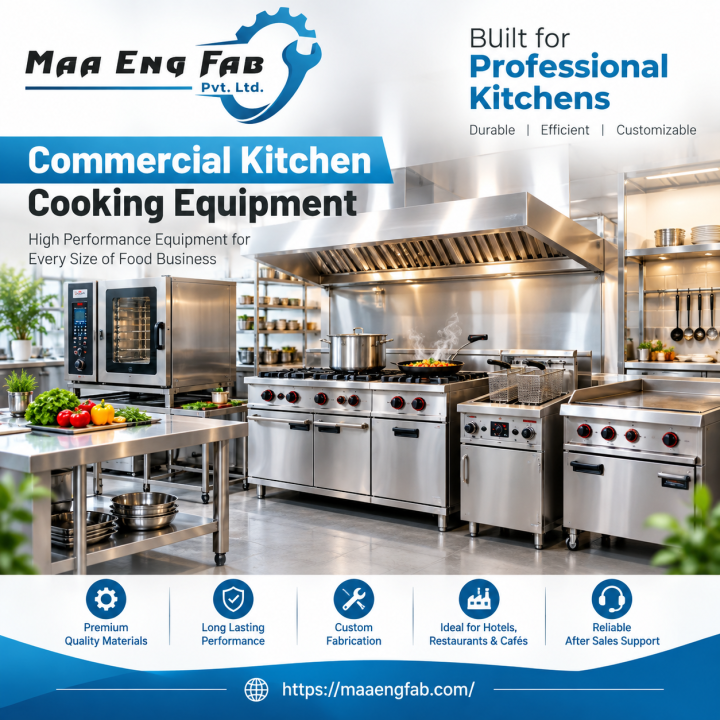
Buying commercial cooking equipment before planning the kitchen workflow can create problems that are difficult and expensive to fix later. A restaurant kitchen is a connected working system where ingredients move through preparation, cooking, holding, plating and dispatch.
If equipment is selected without understanding this movement, even high-quality appliances may fail to deliver the expected productivity.
For this reason, workflow should be considered before finalising Commercial Kitchen Cooking Equipment.
Kitchen workflow refers to the way people, ingredients, equipment and finished food move through the kitchen.
A typical restaurant process may look like:
Receiving → Storage → Preparation → Cooking → Holding → Plating → Dispatch
Each stage needs appropriate space and equipment.
The objective is to minimise unnecessary movement while keeping different activities organised and safe.
When workflow is planned first, equipment can be selected and positioned according to the actual production process.
The menu is one of the biggest factors influencing kitchen workflow.
A restaurant serving Indian curries, rice, fried foods and breads will require different cooking stations from a bakery or a quick-service burger restaurant.
Before selecting Commercial Kitchen Cooking Equipment, identify:
This information helps determine which equipment should be located together and which processes require dedicated stations.
Ingredients should move through the kitchen in a logical direction.
For example, vegetables may move from storage to preparation and then to cooking.
If storage is located far away from preparation areas, staff may repeatedly walk long distances.
Similarly, if cooking equipment is positioned far from preparation counters, employees may waste time transporting ingredients between stations.
A good workflow reduces unnecessary movement without compromising safety or hygiene.
Instead of choosing equipment individually, restaurants should think in terms of complete cooking stations.
A frying station may require:
A bulk cooking station may require:
This approach helps ensure that Commercial Kitchen Cooking Equipment works as part of a complete process rather than as separate appliances.
A kitchen that works efficiently during quiet periods may struggle during peak service.
During busy periods, multiple employees may need to access the same cooking equipment simultaneously.
Before purchasing equipment, restaurants should consider:
The objective is to prevent one equipment station from becoming a bottleneck.
A common mistake is selecting equipment simply because it offers high capacity.
However, large capacity does not guarantee higher kitchen throughput.
For example, a very large fryer may have excellent theoretical output, but if preparation space is limited, staff may not be able to supply it efficiently.
Similarly, a large cooking range cannot improve overall production if plating or dispatch becomes the limiting stage.
Therefore, equipment capacity should always be evaluated alongside workflow.
Commercial kitchens require sufficient clearance around equipment for operation, cleaning and maintenance.
When planning equipment placement, consider:
Poorly positioned equipment can create congestion and make a kitchen slower even when the equipment itself performs well.
Workflow planning should also include utilities.
Cooking equipment may require:
These requirements should be considered before equipment positions are finalised.
A Commercial Kitchen Cooking Equipment manufacturer can provide technical specifications that help planners coordinate equipment with the kitchen's utility infrastructure.
When comparing a Commercial Kitchen Cooking Equipment manufacturer in India, restaurants should look beyond product catalogues.
Important questions include:
A manufacturer that understands workflow can help identify equipment configurations that are better suited to the kitchen's operational requirements.
Restaurants should also compare Commercial Kitchen Cooking Equipment suppliers in India based on construction quality, specifications, customisation, installation and service—not only quotation price.
Workflow planning should not focus exclusively on today's volume.
Restaurants may add:
Planning reasonable flexibility into the kitchen can make future expansion easier.
However, this does not mean buying oversized equipment everywhere. Future capacity should be based on realistic business expectations.
Restaurants should avoid:
Kitchen workflow should be planned before buying Commercial Kitchen Cooking Equipment because equipment performance depends heavily on how it fits into the complete production system.
The right approach is to analyse the menu, understand ingredient movement, identify peak-hour requirements, design cooking stations and then select equipment that supports that workflow.
When evaluating a Commercial Kitchen Cooking Equipment manufacturer, Commercial Kitchen Cooking Equipment manufacturer in India, or Commercial Kitchen Cooking Equipment suppliers, restaurants should consider the complete operational picture rather than selecting equipment based only on size or price.
A well-planned kitchen is not simply one with high-capacity equipment. It is a kitchen where people, ingredients, equipment and finished food move efficiently from one stage to the next.